






お知らせNews
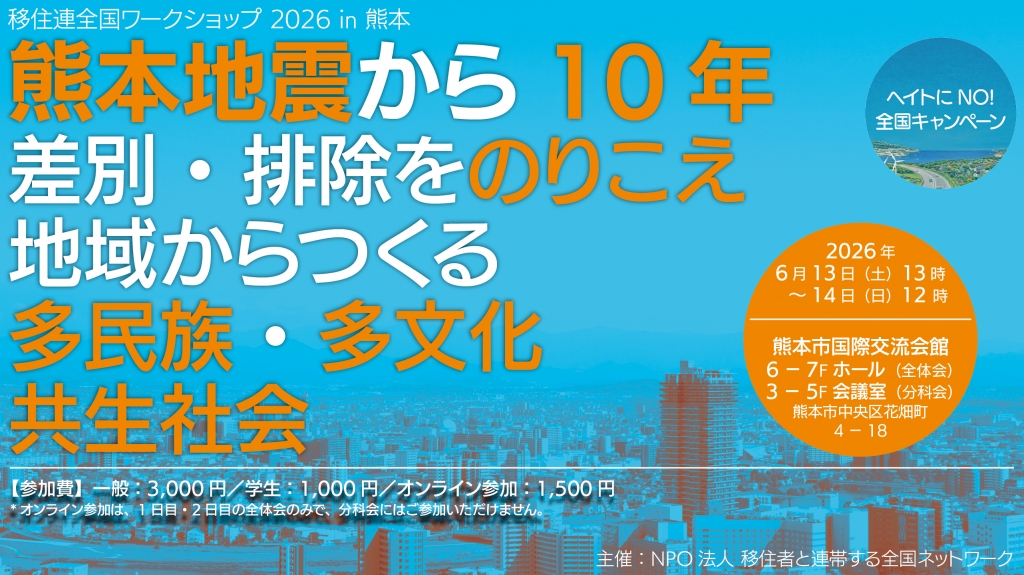
【会場参加は申込締切ました】移住連全国ワークショップ2026 in 熊本(6月13日〜14日)
2026/4/24更新 懇親会は定員に達しましたので受付終了しました。
2026/4/3更新 ワークショップ前日のフィールドワークは定員に達しましたので受付終了しました。
-------------------------------------------------------------------
日本社会はすでに多くの外国人労働者、国際結婚などでの定住者や外国ルーツをもつ子ども・若者らが暮らす移民社会となっており、地域では共生に向けたさまざまな取り組みが始まっています。その一方で、日本政府は、従前のままの外国人管理と非正規滞在者の排除、使い捨て労働力としての外国人労働者受入れ政策を変えようとしないどころか、現政権ではさらに管理・監視重視の政策が推し進められてしまっています。
今年の2日間のワークショップは、今年で震災10年を迎える熊本で開催します。地域における移民社会の実態や取り組みの報告をうけ、課題別テーマでの討論を通し、多民族・多文化共生社会のあり方に今改めて立ち返り、私たちがこれからどのような社会をつくっていきたいか、みなさんと考えたいと思います。
**The English translated version is below
<開催概要>
・日時:2026年6月13日(土)13時00分〜14日(日)12時00分・開催場所:熊本市国際交流会館6-7階ホール(全体会)、3-5階会議室(分科会)
(住所:熊本市中央区花畑町4−18 https://www.kumamoto-if.or.jp/kcic/)
+フィールドワーク参加費 2,000円(希望者のみ、先着15名)
※プログラムの一部をオンラインで参加する場合(例えば、1日目対面参加・2日目オンライン参加など)も、参加費は3,000円(学生は1,000円)です。ご了承ください。
・オンライン参加:1,500円
※オンライン参加は、1日目・2日目の全体会のみで、分科会にはご参加いただけません。
※全プログラムオンライン参加の場合(1日目・2日目全体会ともにオンライン参加の場合)のみ、参加費のお支払いは銀行振込。申込確認後、お振込先等をご連絡します。
➡2026/5/25更新 定員上限に達しましたので、本ワークショップへの参加申込は締め切りました。1日目の全体会・2日目の全体会のオンライン参加は引き続き受け付けております。
プログラム
<【前日(6月12日(金))】フィールドワーク> 13:00-17:00 ※希望者・申込者のみ
→2026/4/3 定員に達しましたので、申込終了しました。
----------------------------------------------
<1日目・6月13日(土)> 13:00-17:30
12:00- 受付開始
13:00-14:45 全体会
報告①「「秩序ある共生社会」報告②「支援から共創へー熊本地震から10年の外国人支援と多文化共生の地域づくり」勝谷知美さん(一般財団法人 熊本市国際交流振興事業団 事務局長)
報告③「
15:00〜17:30 分科会
分科会1:労働 移住労働者の現在地と未来を考える
2026年現在、257万人もの外国籍労働者が日本で働いています。さらに育成就労制度の開始によりいっそう多くの外国籍労働者が日本にやってくることが予想されます。一方、移住労働者の権利保障はいまだ不十分であり、課題は山積しています。労働安全衛生と労使対等原則が保たれた真の多民族・多文化共生社会を実現するため、外国人春闘のはじまりと移住連と共に実施してきたこれまでの省庁交渉を振り返ることで課題の整理を行い、私たちが今後、何をどう取り組んでいくのかを議論します。報告の内容を前提にグループ別に議論を行った後、全体討論を行います。
【報告】省庁交渉の歴史と課題〜どこからスタートしたのか外国人春闘〜
報告者:外国人労働者の生活と権利のための実行委員会、ほか。
【グループディスカッション】数名のグループに分かれてディスカッションを行います。
【全体討論】グループディスカッションの内容を共有し、参加者全体で議論します。
2027年4月より、技能実習制度が廃止され、育成就労制度が始まる。
育成就労は、転籍の可能性、多額の債務の基準、育成就労機構に職業紹介機能が認められる等の点が改善されるという。
しかし、多くの分野で転籍制限期間が2年となり、本人希望での転籍は困難になること。多額の債務での基準違反や、悪質な監理支援機関(監理団体)への規制、同機構の監督指導機能がどこまで可能か等、多くの疑問がある。
また、人手不足への即戦力とされる特定技能は、実際には無権利な非正規労働者として、不当な雇止めや住居に関するトラブル等が絶えない。
排外主義の広がる現状で、日本社会を支える外国人労働者の権利を守り、ともに働く仲間として何をすべきか、どう闘うかを議論していきたい。
分科会3:難民・収容、非正規滞在者の生存権 「ゼロプラン」で強まる排除に抗うー難民・非正規滞在者の尊厳と生存権を守るために
2024年の改定入管法の施行から約2年。入管庁が非正規滞在者の削減をめざす、いわゆる「ゼロプラン」を2025年5月に発表して以来、難民申請の多くを「誤用・濫用的」とみなす言説が強まり、難民申請者の送還や十分な審査を欠いた不認定処分が加速しています。入管収容所の被収容者数の減少傾向がみられる一方で、仮放免者をはじめとする非正規滞在者の医療アクセスや生活保障は極めて不十分なまま放置され、生存権の侵害ともいえる状況が広がっています。
本分科会では、このような状況の中で苦闘する各地の難民・非正規滞在者支援の現場からの報告を受け、日本における難民保護・収容制度のあり方と、非正規滞在者の尊厳と生存権をどのように守っていくのかについて、支援の実践と連帯の可能性を参加者の皆さんとともに考えます。
【報告】
報告1 「ゼロプラン」が問う日本の難民保護―排除の加速の中で 角谷志保美さん(難民支援協会)
報告2 生存権を奪われ強制送還の恐怖に追い込まれる外国人支援の現状と希望を紡ぐ 瀬戸大作さん(反貧困ネットワーク)
報告3 深刻化する非正規滞在者の医療・生存権をめぐる課題―省庁への要請 大川昭博さん(移住連)
報告4 大村からのレポート 柚之原寛史さん(長崎インターナショナル教会)
分科会4:自治体施策 自治体(地域)から排外主義に抗う
2025年7月、「日本人ファースト」を掲げる参政党の躍進にみられるように、排外主義的な動きが高まりつつある。それに後押しされるかのように、政府も、「国民の安心・安全」という名のもとに、外国人に対する管理・監視、排除の強化を推し進めています。
自治体レベルでも、武蔵野市の住民投票条例の否決(2021年12月)、大阪府交野市による不明外国人女性の在留資格取消し要請(2025年7月)、三重県における国籍要件見直しの検討(2025年12月)、「移民政策反対」を掲げた石田氏の福井県知事当選(2026年1月)、茨城県における「不法就労通報制度」の導入(2026年4月~)など、排外主義的な動きが顕著になっています。
けれども、本来、自治体とは、国籍にかかわらず、当該地域に居住する住民の生活と権利を守るべき組織ではないでしょうか。本分科会では、各地の状況、排外主義に抗う自治体の取組みや市民による抵抗運動などについて情報共有するとともに、「共に生きる」社会について考えたいと思います。
【報告】
報告1 モスクをめぐっていま起きていること(仮) 神奈川県藤沢市議 竹村雅夫さん
報告2 埼玉でのクルド人ヘイトの現状と抵抗(仮) 埼玉県さいたま市議 高柳俊哉さん
報告3 急増する外国人住民と地域社会の課題と取組み(仮) 熊本市国際交流振興事業団常務理事 八木浩光さん、一般社団法人minori代表 高木聡史さん
報告4 地域での反差別条例という「抵抗」(仮) 外国人人権法連絡会事務局次長 滝大知さん
分科会5:女性 妊娠したら退職や退学?―韓国と日本における「産む・産まない・育てる権利」をめぐる課題
日本と韓国は、ジェンダー格差が大きく、出生率が低いことから、外国人就労者や留学生への労働力依存を強めています。しかし、在留資格によっては家族帯同を認めず、妊娠を契機に退職・退学が勧奨されたり、帰国を迫られたりする事例が見られます。移民女性は妊娠について相談しづらく、医療につながらぬまま孤立出産に至ることがあります。日本では孤立出産をした技能実習生が死体遺棄罪に問われる事件が相次ぎ、韓国でも同様の例が報告されています。
本分科会では、韓国の活動家を招き、「産まない権利」「産む権利」「安全な環境で子どもを育てる権利」からなるリプロダクティブ・ジャスティスの視点を手がかりに、日韓の制度を比較し、現場での支援と政策レベルで求められる課題について議論します。
【報告】
報告1 「移民のリプロダクティブ・ジャスティスをめぐる交差的抑圧-韓国の事例から」 沈雅亭 シム・アジョンさん (Trans-border-ing Lab)
報告2 「就労/就学に適した身体と母性規範圧力:リプロダクティブ・ジャスティスの視点で見た矛盾」 田中雅子さん(上智大学)
報告3 「情報提供から意思決定支援へ-『外国人のための日本語で学ぶライフプラン』の活用」 高向有理さん(西日本短期大学)
報告4 「コムスタカでの妊娠・出産に関する取り組み」 佐久間順子さん(コムスタカ-外国人と共に生きる会)
分科会6:子ども・若者 外国につながる子どもや保護者の不安や心配を取り除き進路を保障するための取り組みについて
外国につながる子どもたちへの様々なサポートは近年広がりと深化がみられますが、依然としていくつもの「壁」や「課題」が存在しています。
子どもたちの不安定な在留資格による進路についての不安が存在します。この不安を取り除くための相談体制の構築が求められています。
また従来からの課題である子どもたちへの日本語指導や教科指導については、自治体による公的な指導が終了したのちの取り組みや高校進学後の指導についても課題が残っています。
一方で、ベトナム、ネパール、インドネシアなど最近になって増えてきている国の人々の場合は家族を帯同するケースも増えており、就学前の子どもも増加しています。このような家族への日本の学校への就学へ向けての保護者へのガイダンスの必要性もが高まっています。
さらに第二世代や第三世代といった日本で生まれ育っている子どもたちへの母語・継承語指導は保護者にとっては切実な願いであり、一部ではこのことに対する取り組みも行われています。
子ども・若者分科会ではこのような課題への各地での取り組みを報告してもらい、外国につながる子どもたちや保護者の不安や心配に寄り添い、進路を保障するための方策をともに考えたいと思います。
【報告】
報告1 「学び・成長・進路保障のために~在留資格相談体制の構築」について 高橋徹さん (元神奈川県立高校教員 移住連・子ども若者プロジェクト)
報告2 4カ国(フィリピン、ベトナム、インドネシア、ネパール)対象小学校就学ガイダンスの取り組み 井上幸雄さん(アジアに生きる会・ふくおか)
報告3 外国につながる子どもたちへの母語・継承語指導の取り組み ブイ・テイ・トウ・サンゴさん(福岡国際市民協会)
報告4 「外国から来た子ども支援ネットくまもと」の取り組み 岩谷美代子さん(外国から来た子ども支援ネットくまもと)
報告5 「共に歩み青春を語る会の取り組み」 山﨑桃子さん(菊陽町立中学校 教員)
コムスタカー外国人と共に生きる会、2020年に移住者と連帯するネットワーク(移住連)の全国フォーラムを熊本で開催することを目指し、2019年8月から熊本県内および九州各地の移住者コミュニティや支援団体とともに実行委員会を立ち上げ、準備を進めていました。その過程で新たなつながりも生まれ、「熊本の多文化共生を前に進めていこう!」という機運が高まっていました。しかし、2019年末頃に新型コロナウイルスの感染拡大が始まり、2020年に入り、中止せざるをえなくなりました。それから6年を経て、2026年6月に移住連主催のワークショップを熊本で開催することに協力することとなりました。また、今年2026年は2016年4月の熊本地震から10年という区切りの年です。2020年の全国フォーラムでも企画していた「移民コミュニティが集まり、防災・災害対策、地域づくりについて語り合う場」を改めて実現したいと考え、この分科会を設けることにしました。
熊本県内の外国籍住民は、2015年12月末約1万人程度の外国籍人口が10年経過した2026年には3万人を超えて3倍以上に、技能実習生や特定技能の在留者など就労関係の増加が目立ちます。一方。外国人に対する差別はこれまでも根強く存在してきましたが、この1年で排外主義はさらに強まっています。しかし、日本はすでに多民族・多文化社会であり、移民の存在なしに日本社会は成り立ちません。だからこそ、いま全国から集まり、顔を合わせ、つながりを確かめ合い、この排外主義に抗いながら、多文化共生社会を前に進めることが必要だと感じます。この分科会では、防災・災害時の取り組み、新たに来日する移民との関係づくり、差別や排除の動きと地域作りなどを論点とした報告や議論を行いたいと考えています。
【報告】
報告1 熊本地震から10年!防災・災害時の取り組みと今後の地域作り ミッチェル アンドリューさん(熊本大学 KEEP代表)
報告2 熊本県内の外国籍コミュニテイの現状と課題 中国・フイリピン・ベトナム・ネパール・インドネシア等の在住外国籍住民から
報告3 全国各地の参加者から移民コミュニテイの報告
【質疑討論】
防災・災災害時の取組み
新たに来日する移民との関係づくり
差別や排除の動きと地域作り
18:00〜20:00 夕食・交流会(場所:IRISH PUB CELTS 熊本下通り店 https://celts.dkdining.com/kumamoto/)
注意:申込者のみ。夕食・交流会の申込受付は定員に達し次第終了予定。
→2026/4/24 定員に達しましたので、申込終了しました。
<2日目・6月14日(日)> 9:30~12:00
9:30-10:20 全体会 1 各分科会から報告
10:30-12:00 全体会 2 ディスカッション「ヘイトにNO!共生社会を地域から」
・ヘイトにNO! 全国キャンペーンの経過報告・各地の取り組みから 報告者:鳥井一平さん(移住連共同代表理事)・外国人人権基本法・人種差別撤廃基本法の提案 報告者:丹羽雅雄さん(弁護士、外国人人権法連絡会)
12:00 終了
※終了後、13時〜14時に同じ会場で2026年度移住連会員総会を開催します。
(総会議案と詳細は追って移住連会員のみなさまにお送りします。)
SMJ National Workshop 2026 in Kumamoto
Japanese society has already become an immigrant society, where many foreign workers, long-term residents through international marriage, and children and young people with foreign roots live together. At the community level, various initiatives toward coexistence have begun to take shape. At the same time, however, the Japanese government has not only failed to change its long-standing approach of strict control over foreign residents, the exclusion of undocumented migrants, and the acceptance of foreign workers as disposable labor, but under the current administration, policies emphasizing control and surveillance are being further intensified.
This year’s two-day workshop will be held in Kumamoto, which marks the 10th anniversary of the earthquake. Through reports on the realities of immigrant communities and local initiatives, as well as discussions on specific thematic issues, we hope to revisit the vision of a multiethnic and multicultural society. Together with all participants, we aim to reflect on what kind of society we want to build going forward.
Dates/Times: Sat 13, 13:00 - Sun 14, 12:00, June 2026
Place: Kumamoto City International Center 6-7F(for the keynote speech on 13th, the plenary sessions on 14th), 3-5F meeting rooms(for breakout sessions on 13th)
(Address: 4-18 Hanabata-cho, Chuo-ku, Kumamoto-shi:https://www.kumamoto-if.or.jp/kcic/)
Payment: Cash on site (Please be prepared to bring change)
/ Fieldwork ¥2,000 (On request / The registration will be closed once the capacity is reached)
※The participation fee is going to be \3,000 (or \1,000 for students) for those attending in part of the program online.
¥1,500 for online participants
※Online participation is only available for the keynote speech on 13th and the plenary sessions on 14th.
※For online participants only (for those attending online in both of the keynote speech on 13th and the plenary sessions 14th), the participation fee must be paid by bank transfer. Bank details and payment instructions will be provided after your registration has been confirmed.
**Accommodation is NOT provided, so please make sure to book accommodation and the means of transportation by yourself.
Program
<[Day Before (Friday, June 12)] Fieldwork> 13:00–17:00
For those who wish to participate and have registered in advance only
→The application is closed on 2026/4/3 as the capacity has been reached.
Fieldwork locations: TSMC, the Japan Self-Defense Forces’ Western Army Headquarters in Kengun, and disaster-affected areas around Mashiki.
Meeting time and place:
- ・By Shinkansen: 12:00 @ JR Kumamoto Station
- ・By airplane: 13:00 @ Kumamoto Airport (Parking Lot No. 2) [tentative]
※Participants will carpool from Kumamoto Station to Kumamoto Airport Parking Lot No. 2, and then proceed together to the fieldwork sites.
----------------------------------------------
<Day 1, 13th June>
12:00 Reception starts
13:00 - 14:45 Keynote speech
Report 1: Strengthening the Control and Exclusion of Foreigners in the Name of a “Well-Ordered Coexistence Society”
Eriko Suzuki (Co-Representative Director, Solidarity Network with Migrants Japan)
Report 2: From Support to Co-Creation: 10 Years of Foreign Resident Support and Multicultural Community Building since the Kumamoto Earthquake
Tomomi Katsutani (Secretary General, Kumamoto City International Foundation)
Report 3: The History and Initiatives of Kumustaka-Association for Living Together with Migrants, Toward Participation in a Multicultural Society
Shinichiro Nakajima (Representative, Kumustaka-Association for Living Together with Migrants)
15:00-17:30 Breakout Sessions
Session1 Labor Considering the Present and Future of Migrant Workers
As of 2026, as many as 2.57 million foreign workers are employed in Japan. With the introduction of the new “Training and Employment System,” it is expected that even more foreign workers will come to Japan. However, the protection of migrant workers’ rights remains insufficient, and many challenges persist.
In order to realize a truly multiethnic and multicultural society—one in which occupational safety and health are ensured and the principle of equality between labor and management is upheld—we will review the history of the “Foreign Workers’ Spring Labor Offensive” and past negotiations with government ministries conducted together with the Solidarity Network with Migrants Japan (SMJ). Through this, we aim to clarify the key issues and discuss what actions we should take moving forward.
Following the presentations, participants will engage in group discussions, and then move on to a plenary discussion.
[Presentation]
History and Challenges of Negotiations with Government Ministries: Where Did the Foreign Workers’ Spring Labor Offensive Begin?
Presenter: Executive Committee for the Protection of the Lives and Rights of Foreign Workers, and others
[Group Discussion] Participants will be divided into small groups for discussion.
[Plenary Discussion] Key points from the group discussions will be shared, followed by a discussion with all participants.
From April 2027, the Technical Intern Training Program will be abolished and replaced by the new “Training and Employment System.”
It is said that the new system will bring improvements, such as the possibility of job transfers, the establishment of standards regarding excessive debt, and the authorization of the Training and Employment Organization to provide job placement services.
However, there are still many concerns. In many sectors, restrictions on job transfers will remain in place for up to two years, making it difficult for workers to change jobs at their own initiative. There are also questions about how effectively violations related to excessive debt will be addressed, how strictly problematic supervising organizations will be regulated, and to what extent the new organization will be able to exercise its supervisory and enforcement functions.
Furthermore, the Specified Skilled Worker program—often described as an immediate solution to labor shortages—has in reality left workers in precarious, low-rights positions, with ongoing issues such as unfair termination and housing-related problems.
At a time when xenophobia is on the rise, we aim to discuss how we can protect the rights of foreign workers who support Japanese society, and what actions we should take—and how we should organize and advocate—as fellow workers.
Session3 Refugees, Detention, and the Rights to Life of Undocumented Persons Resisting Intensified Exclusion under the “Zero Plan”: Protecting the Dignity and Right to Life of Refugees and Undocumented Migrants
Nearly two years have passed since the enforcement of the revised Immigration Control Act in 2024. Since the Immigration Services Agency announced the so-called “Zero Plan” in May 2025—aimed at reducing the number of undocumented migrants—there has been a growing discourse that frames many asylum applications as “misuse” or “abuse.” As a result, deportations of asylum seekers and rejections without sufficient examination have been accelerating.
While the number of detainees in immigration detention centers has shown a declining trend, access to healthcare and basic livelihood support for undocumented migrants, including those under provisional release, remains insufficient. This situation amounts to a serious violation of the right to life and dignity.
In this session, we will hear reports from those working on the front lines supporting refugees and undocumented migrants across Japan who are struggling under these conditions. Together with participants, we will reflect on the state of refugee protection and the detention system in Japan, and consider how we can safeguard the dignity and right to life of undocumented migrants through practical support and solidarity.
[Reports]
Report 1: Refugee Protection in Japan under the “Zero Plan”: Amid Accelerating Exclusion Shiomi Kakutani (Japan Association for Refugees)
Report 2: Current Realities of Supporting Foreign Nationals Deprived of the Right to Life and Driven into Fear of Deportation—and Weaving Hope Daisaku Seto (Anti-Poverty Network)
Report 3: Deepening Challenges Surrounding Healthcare and the Right to Life for Undocumented Migrants: Policy Advocacy to Government Ministries Akihiro Okawa (Solidarity Network with Migrants Japan)
Report 4: Report from Ōmura Hiroyuki Yunohara (Nagasaki International Church)
Session4 Municipal Policies Resisting Xenophobia from the Local Level: The Role of Municipalities and Communities
In July 2025, the rise of the Sanseitō party—promoting a “Japanese First” platform—highlighted a growing wave of xenophobic sentiment. In parallel, the national government has been advancing policies that strengthen the control, surveillance, and exclusion of foreign nationals under the banner of “public safety and security.”
At the municipal level as well, xenophobic trends have become increasingly visible. These include the rejection of a local referendum ordinance in Musashino City (December 2021), a request by Katano City in Osaka Prefecture to revoke the residency status of a foreign woman whose whereabouts were unknown (July 2025), discussions in Mie Prefecture on revising nationality requirements (December 2025), the election of Mr. Ishida—who campaigned on an anti-immigration platform—as Governor of Fukui Prefecture (January 2026), and the introduction of a “reporting system for illegal employment” in Ibaraki Prefecture (from April 2026).
However, municipalities are, in principle, institutions that should protect the lives and rights of all residents living in their communities, regardless of nationality. In this session, we will share information on local conditions, initiatives by municipalities resisting xenophobia, and grassroots movements led by citizens. Together, we aim to reflect on what it means to build a society where people can truly “live together.”
[Reports]
Report 1: What Is Happening Around Mosques Today (tentative) Masao Takemura, City Council Member, Fujisawa City, Kanagawa Prefecture
Report 2: The Current State of Anti-Kurdish Hate in Saitama and Forms of Resistance (tentative) Toshiya Takayanagi, City Council Member, Saitama City, Saitama Prefecture
Report 3: Rapidly Increasing Foreign Residents: Challenges and Local Initiatives (tentative) Hiromitsu Yagi, Executive Director, Kumamoto International Foundation / Satoshi Takagi, Representative, General Incorporated Association minori
Report 4: Anti-Discrimination Ordinances as “Resistance” at the Local Level (tentative) Daichi Taki, Deputy Secretary-General, Lawyers’ Network for Foreign Residents’ Rights
Session5 Women Resign or Drop Out if You Become Pregnant? — Challenges Surrounding the Right to “Not Have Children, to Have Children, and to Raise Children” in Japan and South Korea
Japan and South Korea both face significant gender inequality and low birth rates, leading to an increasing reliance on foreign workers and international students as part of their labor force. However, depending on visa status, family accompaniment is often not permitted, and there are cases where individuals are encouraged to resign from work or withdraw from school upon becoming pregnant, or are even pressured to return to their home countries.
Migrant women often find it difficult to seek advice about pregnancy, and some end up giving birth in isolation without access to medical care. In Japan, there have been a series of cases in which technical intern trainees who gave birth alone were charged with abandonment of a corpse. Similar cases have also been reported in South Korea.
In this session, we will invite an activist from South Korea and use the framework of reproductive justice—encompassing the right not to have children, the right to have children, and the right to raise children in a safe environment—to compare systems in Japan and South Korea. We will also discuss both practical support on the ground and the policy-level changes needed.
[Reports]
Report 1: Intersectional Oppression Surrounding Migrants’ Reproductive Justice: Insights from South Korea Ajeong Shim (Trans-border-ing Lab)
Report 2: “Bodies Suitable for Work/Study” and the Pressure of Maternal Norms: Contradictions from a Reproductive Justice Perspective Masako Tanaka (Sophia University)
Report 3: From Information Provision to Decision-Making Support: Utilizing “Life Planning in Japanese for Foreign Residents” Yuri Takamukai (Nishinippon Junior College)
Report 4: Initiatives on Pregnancy and Childbirth at Comstaka Junko Sakuma (Comstaka – Living Together with Foreign Residents)
Session6 Children and Youth Initiatives to Reduce Anxiety and Ensure Educational Pathways for Children with Migrant Backgrounds and Their Parents
In recent years, support for children with migrant backgrounds has expanded and deepened. However, many “barriers” and challenges still remain.
One major concern is the uncertainty surrounding children’s future educational and career pathways due to unstable residence statuses. There is a growing need to establish consultation systems that can help alleviate these concerns.
In addition, long-standing challenges remain in providing Japanese language education and subject instruction. Issues persist regarding support after municipal programs end, as well as continued support after students advance to high school.
At the same time, there has been an increase in families from countries such as Vietnam, Nepal, and Indonesia in recent years, many of whom come with their children. As a result, the number of pre-school-aged children is also rising, and there is a growing need to provide guidance to parents on enrolling their children in Japanese schools.
Furthermore, for second- and third-generation children born and raised in Japan, instruction in their mother tongues and heritage languages is a pressing concern for parents. Some initiatives addressing this issue have already begun.
In this session on children and youth, we will hear reports on efforts from across different regions and, together with participants, consider ways to support children with migrant backgrounds and their parents—addressing their concerns and ensuring their educational and life pathways.
[Reports]
Report 1: Ensuring Learning, Growth, and Future Pathways: Building a Consultation System for Residence Status Toru Takahashi (Former Kanagawa Prefectural High School Teacher; SMJ Children and Youth Project)
Report 2: Initiatives for Elementary School Enrollment Guidance for Families from Four Countries (Philippines, Vietnam, Indonesia, Nepal) Yukio Inoue (Association for Living in Asia, Fukuoka)
Report 3: Mother Tongue and Heritage Language Education for Children with Migrant Backgrounds Bui Thi Thu Sang (Fukuoka International Citizens Association)
Report 4: Initiatives of the “Kumamoto Network for Supporting Children from Overseas” Miyoko Iwatani (Kumamoto Network for Supporting Children from Overseas)
Report 5: Initiatives of the “Walking Together and Sharing Youth” Group Momoko Yamazaki (Junior High School Teacher, Kikuyō Town)
Session7 Community Building among Foreign Residents 10 Years Since the Kumamoto Earthquake: Toward Community Building for Multicultural Coexistence and Participation
Comstaka – Living Together with Foreign Residents had been working toward hosting the nationwide forum of the Solidarity Network with Migrants Japan (SMJ) in Kumamoto in 2020. Beginning in August 2019, an organizing committee was formed together with migrant communities and support organizations across Kumamoto Prefecture and the wider Kyushu region, and preparations were underway. Through this process, new connections were formed, and momentum grew around the idea of advancing multicultural coexistence in Kumamoto.
However, the spread of COVID-19 infections beginning in late 2019 forced the cancellation of the event in 2020. Six years later, in June 2026, we are now collaborating to host an SMJ workshop in Kumamoto. This year also marks the 10th anniversary of the April 2016 Kumamoto Earthquake. We have therefore decided to organize this session in order to finally realize what had been planned for the 2020 forum: a space where migrant communities can come together to discuss disaster preparedness, disaster response, and community building.
The number of foreign residents in Kumamoto Prefecture has increased significantly—from around 10,000 at the end of December 2015 to over 30,000 in 2026, more than tripling over the past decade. This growth has been particularly notable among workers under programs such as Technical Intern Training and Specified Skilled Worker. At the same time, discrimination against foreign residents has long persisted, and xenophobia has intensified further over the past year.
Yet Japan is already a multiethnic and multicultural society, and it cannot function without migrants. Precisely for this reason, we believe it is crucial for people from across the country to come together, meet face-to-face, reaffirm connections, and work collectively to resist xenophobia while advancing a multicultural society.
In this session, we will engage in presentations and discussions on key themes such as disaster preparedness and response, building relationships with newly arriving migrants, and community building in the face of discrimination and exclusion.
[Reports]
Report 1: 10 Years Since the Kumamoto Earthquake: Disaster Preparedness, Response, and Future Community Building Andrew Mitchell (Kumamoto University; Representative, KEEP)
Report 2: Current Situation and Challenges of Foreign Resident Communities in Kumamoto Speakers from Chinese, Filipino, Vietnamese, Nepali, Indonesian, and other migrant communities
Report 3: Reports on Migrant Communities from Participants Across Japan
[Discussion / Q&A]
- Disaster preparedness and response initiatives
- Building relationships with newly arriving migrants
- Community building amid discrimination and exclusion
https://celts.dkdining.com/kumamoto/
** Only for people who registered. The registration will be closed once capacity is reached.
→The application is closed on 2026/4/24 as the capacity has been reached.
----------------------------------------------
<Day 2, 14th June> 9:30-12:00
9:30-10:20 Plenary Session 1 Reports from Breakout Sessions
10:30-12:00 Plenary Session 2 Discussion: "NO!to Hate, Toward an Inclusive Society Starting from the Community"
・Progress Report on the “No to Hate” Nationwide Campaign and Initiatives from Across Japan Ippei Torii (Co-Representative Director, Solidarity Network with Migrants Japan)・Proposal for a Basic Act on the Human Rights of Foreign Nationals and a Basic Act on the Elimination of Racial Discrimination Masao Niwa (Lawyer, Lawyers’ Network for Foreign Residents’ Rights)